In this guide
Retirement administration can involve several offices even when the employee thinks of it as one transition. A pension inquiry, a health benefits question, a payroll record, and the return of workplace property have different purposes. A handoff file should show which office owns each question instead of assuming that one conversation starts every process.
The Boston Retirement Board page and the City retiree benefits page, checked October 2, 2026, provide separate official resources. Confirm your applicable instructions directly. This article does not recommend a retirement date, pension option, insurance choice, or financial strategy.
Create a contact map before a document pile
Start with four headings: retirement administration, health benefits, departmental HR or payroll, and workplace handoff. Under each, write the question you need answered and the current official contact. A fifth heading can hold questions that have not yet been routed.
Mark proposed dates as proposed. Do not let a date used for an information request become an apparent commitment in another office’s file. Ask what forms, notices, and confirmation are required before any date or election is treated as final.
Request the current document list
Ask each office for its own checklist and submission instructions. Record whether a document is needed for an estimate, a review, or a formal application. Those purposes should not be merged under a generic “retirement submitted” label.
Keep personal records in the appropriate private file, and avoid putting bank details or full identity documents into a shared transition checklist. The everyday checklist can state that an item is available or submitted without reproducing it.
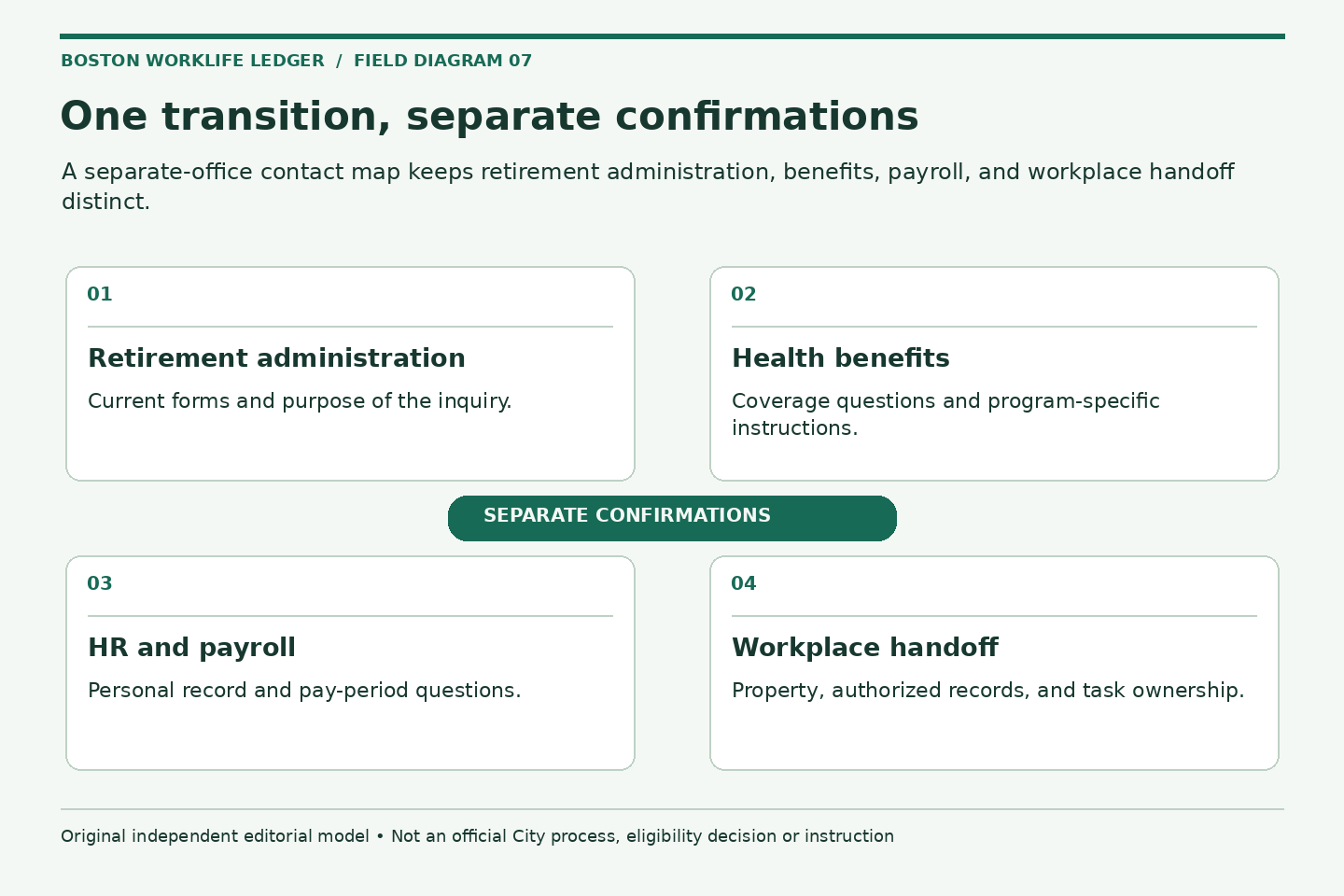
Handoff checklist
- Questions grouped by responsible office
- Proposed dates separated from confirmed instructions
- Current forms and document requirements obtained directly
- Submission and acknowledgment tracked for each process
- Property, work records, and task ownership handled through departmental instructions
- Unanswered timing or coverage questions left visibly open
For any question involving Medicare or another federal program, ask how it interacts with the City process and use that program’s official resources. A City benefits form is not evidence that a separate federal enrollment or determination has been completed.
A hypothetical planning file
Imagine an employee exploring a future transition. They ask the Retirement Board which information is required for the relevant inquiry, while separately asking Health Benefits what questions should be addressed about coverage. Their departmental handoff list remains labeled “planning.”
When an office sends instructions, the employee records the purpose of those instructions and any next step. They do not assume that requesting information has selected a pension option or established a final separation date. The example illustrates administration only.
Do not let related records disappear
A beneficiary form review may involve a separate program and its own acknowledgment. A benefits billing statement may require a period-specific explanation. Keep those tasks linked to the transition file without declaring them complete merely because another office has responded.
Ask how you should obtain appropriate personal records before access arrangements change, following employer instructions. Do not export internal work material or confidential third-party records to preserve a personal archive.
Verify the final handoffs
For each office, record what has been received, what has been determined, and what remains to be done. Compare the confirmed dates and next steps across the files, then ask about conflicts. The administrative goal is a coherent set of instructions, not a self-created calculation or a substitute for individualized professional advice.
Related reading: Check a beneficiary form as a separate administrative task, What to record when a separate benefits bill arrives.