In this guide
- Separate three questions that sound similar
- Do not merge City policy, federal FMLA, and state PFML
- Create a scheduling page with explicit uncertainty
- Ask where each piece of information belongs
- A hypothetical conversation plan
- Prepare a work handoff that avoids personal disclosure
- Write down the answer without overstating it
- Sources and scope
A conversation about leave often begins with a practical uncertainty: a date may change, a return schedule is not known, or the employee does not know which form to request. You do not need a complete personal narrative to begin organizing the administrative questions. A short record of work-related facts can help the appropriate office identify the next step.
Official pages were reviewed October 2, 2026. The City employee handbook covers several leave categories and directs represented employees to applicable collective bargaining agreements for relevant provisions. Treat this article as meeting preparation. It does not determine entitlement, pay, job protection, or the medical need for leave.
Separate three questions that sound similar
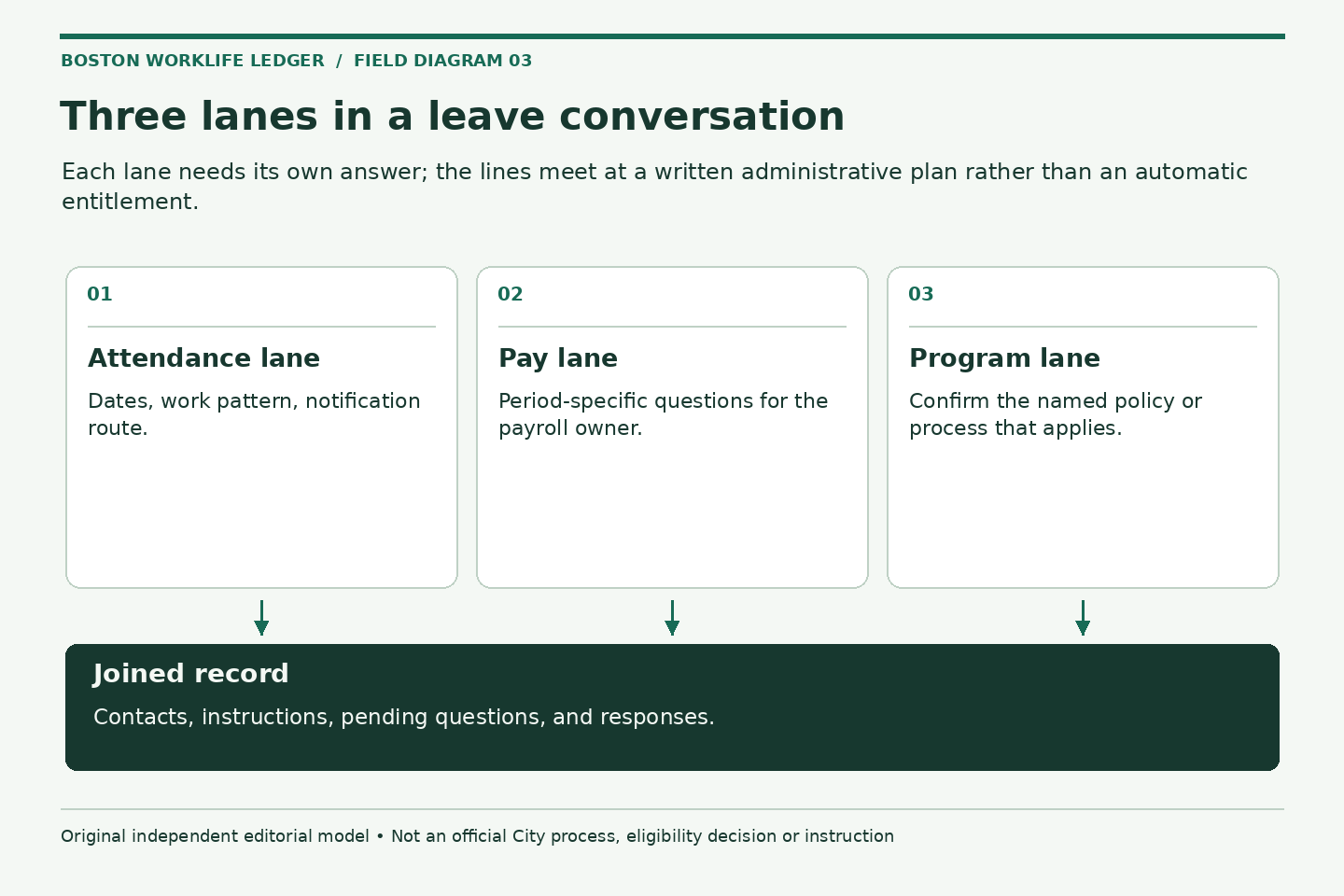
The first question is about absence: how should time away be requested and recorded? The second is about pay: which administrator can explain how the approved arrangement will appear in payroll? The third is about any applicable protection or benefit program: which process is actually under review?
These questions may be related, but the answers are not interchangeable. A supervisor’s awareness of an absence is not necessarily a benefits determination. A balance on a screen does not itself establish permission to use time for a particular purpose. Write the three questions separately so an answer to one does not accidentally close the others.
Do not merge City policy, federal FMLA, and state PFML
Massachusetts PFML guidance for excluded employers says municipalities are excluded unless their governing bodies opt in. That rule is a reason to verify your actual employer and applicable program, not a finding about your own coverage. A Massachusetts workplace address alone does not settle the question.
Ask the leave administrator which City policy, collective bargaining provision, federal process, or state program is relevant to the request. Write each program’s name exactly as supplied. If two processes apply, ask whether they require separate forms, separate notices, or coordinated dates. This guide does not calculate how different leave programs interact.
Create a scheduling page with explicit uncertainty
List your normal work pattern, the date you first expect an effect on attendance, and whether the anticipated change is continuous, intermittent, or still unknown. Mark estimates clearly. A projected return date should not look like a confirmed promise if a responsible professional or administrator has not established it.
Include the contact arrangement you can reasonably discuss: which method should be used for administrative updates, who needs notice of a schedule change, and how an urgent change should be communicated. Do not place clinical details in a shared team calendar. The calendar usually needs an operational status, while any requested supporting documentation belongs in the designated confidential process.
Ask where each piece of information belongs
- Who should receive the initial notice about attendance?
- Who supplies the current leave forms and confirms submission timing?
- Which office receives supporting documentation, and through what channel?
- Who can explain payroll and benefits questions during the absence?
- What should be submitted if a proposed schedule changes?
- What confirmation or further instructions should arrive before the return?
These questions are useful even when you have not settled the full schedule. If an office requires information you do not yet have, ask how to record the uncertainty and what follow-up is expected. Never insert a guessed date or professional conclusion just to make a required field disappear.
A hypothetical conversation plan
Consider an employee who expects recurring appointments but does not yet know the final pattern. Their preparation note lists the normal shift, the first known appointment date, and the statement that additional dates remain unconfirmed. The employee asks the designated leave contact which process applies and what documentation, if any, is required.
In a separate conversation with the supervisor, the employee asks how to communicate approved schedule changes and transfer time-sensitive assignments. The two conversations serve different purposes. Neither example establishes eligibility or directs the employee to use a particular leave category.
Prepare a work handoff that avoids personal disclosure
A handoff can contain the task, current status, deadline, approved backup contact, and location of work records. It does not need the reason for the absence. Mark decisions that the backup can make and decisions that must go to the supervisor. This prevents an absence from becoming an informal transfer of authority.
If equipment, location, or responsibilities may change, the workplace change checklist helps keep those operational questions separate. When an adjustment to work duties is part of the discussion, see preparing accommodation request notes for a task-focused way to describe a barrier.
Write down the answer without overstating it
After a conversation, record the contact, date, forms requested, and unresolved questions. Distinguish “instructions received,” “request submitted,” and “determination received.” If you receive an explanation verbally, ask how to obtain the relevant written instructions. A personal call note is helpful context but is not the employer’s official determination.
Check any response against the dates and work pattern you actually requested. If the response addresses only one component, ask a narrow follow-up about the remaining component. For an unexpected benefit invoice during an absence, use the benefits billing letter checklist rather than assuming the invoice is already explained by the leave approval.
The useful end product is a modest administrative map: the responsible contacts, the current instructions, the known dates, and the next unanswered question. That map can change as circumstances become clearer without forcing private details into every workplace conversation.
Related reading: The administrative handoff for a changed worksite or assignment, Describe the work barrier before assembling accommodation paperwork, What to record when a separate benefits bill arrives.